
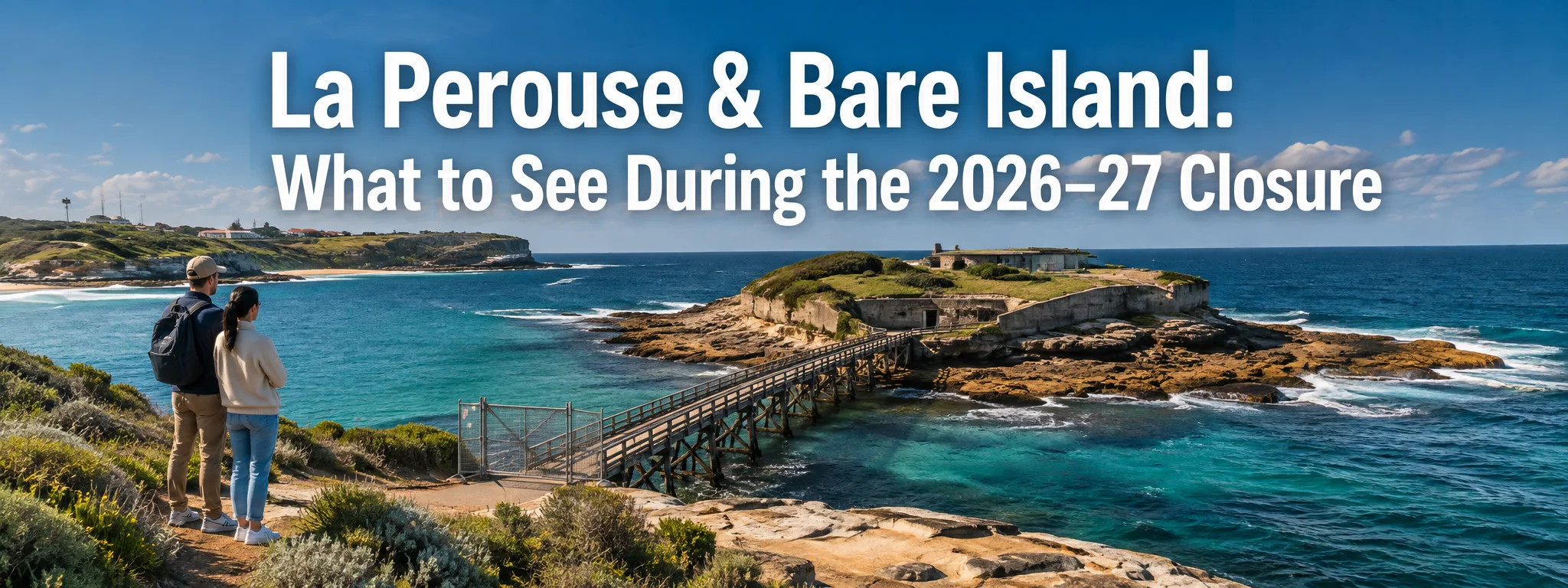
La Perouse is still worth visiting in 2026, but Bare Island itself is currently closed — and that changes the experience enough that older Sydney guides are now misleading.
NSW National Parks closed the Bare Island precinct from 24 August 2026 for major repairs to the timber bridge. The closure includes the access road, bridge, rock shelf and Bare Island Fort, and is expected to continue until late 2027.
So if you have seen photos of travellers walking across the footbridge to the fort, do not build your current itinerary around doing the same thing.
The good news is that La Perouse is more than Bare Island. The headland, museum, beaches, Aboriginal heritage and Botany Bay scenery still make this one of Sydney's more interesting off-centre coastal stops.
Important 2026–27 closure
Bare Island, its access bridge, rock shelf and fort are closed from 24 August 2026 and are expected to remain closed until late 2027 while bridge repairs are carried out. You can still visit La Perouse, but you cannot currently walk onto Bare Island.
Why La Perouse is worth the trip
La Perouse sits at the northern entrance to Botany Bay, south of the CBD and close to Sydney Airport.
It feels different from the postcard harbour attractions. The landscape is lower, windier and more exposed, with views across Botany Bay rather than toward the Opera House skyline.
The area is also historically layered. It has deep significance to Aboriginal communities, and its European name comes from French explorer Jean-François de Galaup, Comte de Lapérouse, whose expedition reached Botany Bay in January 1788 only days after the First Fleet.
Those stories overlap here rather than existing as one neat colonial narrative.
Bare Island: what is closed?
The closure is substantial.
According to NSW National Parks, the following are closed during the bridge-repair project:
- the access road to the island precinct;
- the timber footbridge;
- the surrounding rock shelf;
- Bare Island Fort itself.
Fencing and construction crews are on site.
That means you should not expect to cross the bridge, join a fort tour or scramble around the rock shelf for photographs during the closure period.
You can still view the island from the La Perouse headland.
What to do instead
Visit La Perouse Museum
The museum occupies the historic Cable Station and is one of the strongest reasons to visit while Bare Island is inaccessible.
It covers the French expedition, local history and the wider story of the area.
The museum is operated by Randwick City Council within Kamay Botany Bay National Park.
Check opening hours before travelling because a museum schedule is less forgiving than an open coastal walk.
Walk the headland
The headland remains an excellent place for a low-key coastal wander.
You get views across Botany Bay, toward the island and along the sandstone coastline without the crowds of Bondi or Circular Quay.
On windy days it can feel dramatically exposed, so bring a layer even if the CBD feels warm.
Congwong Beach
Congwong is a small, relatively sheltered beach near La Perouse and a popular local swimming spot.
It can be a pleasant addition to a summer visit, but use normal Sydney beach-safety judgement rather than assuming sheltered water means no risk.
National Parks recommends swimming at patrolled beaches where possible and following Beachsafe advice.
Little Congwong
Little Congwong sits beyond Congwong and has long had an informal clothing-optional reputation.
That may be useful or irrelevant depending on the visitor, but it is worth knowing before arriving with children and being surprised by the local culture.
Snorkelling and diving
The La Perouse area is well known among Sydney divers, particularly around Bare Island.
However, the current closure affects the Bare Island rock shelf and access area, so do not assume older dive-entry advice remains usable during construction.
Check current local conditions and access restrictions before planning a dive.
Aboriginal history is not a side note here
La Perouse has one of Sydney's longest-continuing Aboriginal communities.
Visitors should treat that as central to the area's identity rather than a paragraph added after the French explorer story.
The museum and local cultural programs can provide much better context than simply photographing the headland and leaving.
If Aboriginal cultural experiences are operating during your visit, they can make this stop considerably more meaningful.
The French connection
The Lapérouse expedition arrived at Botany Bay in January 1788 and remained for several weeks.
The coincidence with the First Fleet's arrival is one of those pieces of Sydney history that sounds almost invented: British and French expeditions operating in the same bay at a pivotal moment in Australian colonial history.
The French explorer departed and was later lost in the Pacific, adding another layer to the site's story.
How La Perouse compares with Watsons Bay
Watsons Bay and La Perouse are both headland destinations, but they serve different trips.
Watsons Bay: easier from central Sydney, harbour entrance views, ferry journey, The Gap and a stronger “classic Sydney” feel.
La Perouse: Botany Bay, French and Aboriginal history, beaches, a less tourist-heavy atmosphere and a more suburban/coastal feel.
For a first two-day Sydney visit, Watsons Bay usually ranks higher. For repeat visitors or anyone interested in less obvious Sydney history, La Perouse can be more rewarding.
Opening and park access
NSW National Parks lists the La Perouse area as generally open:
- 7am–8.30pm from November to March;
- 7am–7.30pm from April to October.
The vehicle entry gate closes overnight, and areas can close because of weather, fire danger or works.
There is no general park entry fee for the La Perouse area.
Accessibility
The museum has limited accessibility.
National Parks describes wheelchair access as difficult: the downstairs section can be accessed with assistance, while the upstairs area is inaccessible because of a narrow stairway.
The broader headland includes uneven outdoor surfaces.
If step-free access is essential, contact the museum or park managers before making a special trip.
Getting there
La Perouse is less convenient than the inner harbour but still reachable by public transport.
Bus routes connect the area with the eastern suburbs and city network. Travel time depends heavily on your starting point and traffic.
If you are coming from the airport or southern/eastern suburbs, the geographic position can make more sense than travelling first into Circular Quay and then back out again.
How long to allow
With Bare Island closed, two to three hours is enough for most visitors to see the museum, walk the headland and visit a nearby beach.
Add more time if you are swimming, eating locally or exploring Kamay Botany Bay National Park more broadly.
Common mistakes
Following old advice that says “walk across to Bare Island”. You cannot currently do that.
Making Bare Island the only reason for the trip. La Perouse still has enough history and scenery to justify a visit.
Treating the French story as the whole history. The Aboriginal community and Country are fundamental to the area.
Assuming the museum is fully accessible. The heritage building has real limitations.
Using old dive-access information. The current construction closure affects the island rock shelf and access precinct.
Bottom line
La Perouse remains one of Sydney's better off-the-beaten-path excursions, but 2026–27 visitors need realistic expectations.
Do not travel across the city expecting to walk onto Bare Island: the island precinct is closed until major bridge repairs are complete, currently expected in late 2027.
Go instead for the museum, the Botany Bay headland, beaches, local Aboriginal history and a quieter side of Sydney's coast.


